

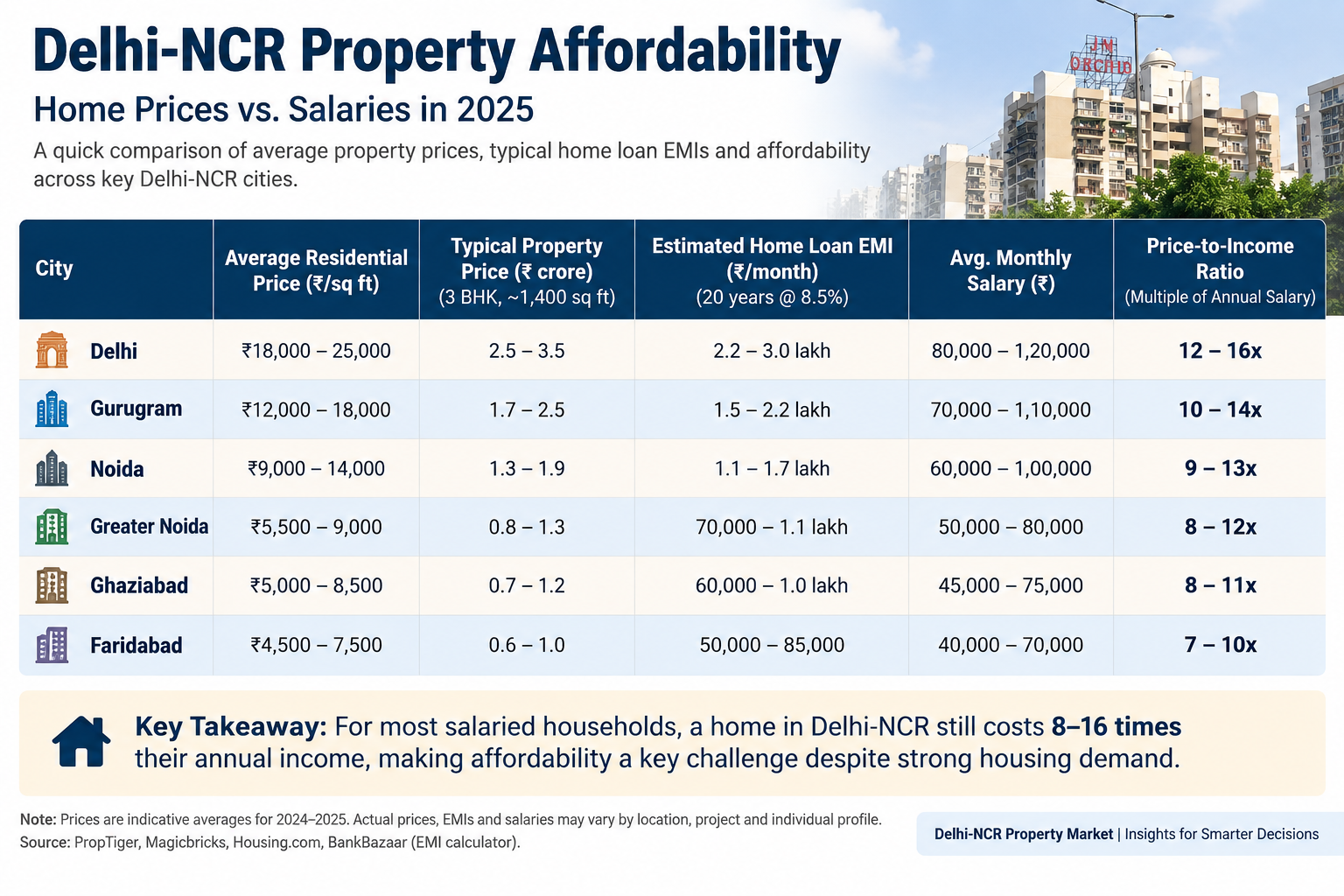
Delhi NCR Property Affordability: Prices Have Changed Dramatically
A ₹1.25 Lakh Salary — But Can You Afford a ₹1.25 Crore Home?
Delhi NCR property affordability has become a major concern as home prices have risen sharply compared with the purchasing power of many salaried buyers.
A monthly salary of ₹1 lakh or ₹1.25 lakh is generally considered a respectable income in India. Yet in Delhi-NCR, even this level of income may no longer be enough to comfortably buy a normal two-bedroom home in many established locations.
This raises an important question for the future of Delhi-NCR residential real estate: Are property prices rising faster than the purchasing power of the people who are actually supposed to buy these homes?
This is not an argument that Delhi-NCR property prices are about to crash. Nor is it a prediction that housing demand will disappear. It is an affordability question — and one that buyers and investors should probably start taking much more seriously.
Delhi NCR Property Affordability: Prices Have Changed Dramatically
Residential prices across Delhi-NCR have increased substantially over the last few years. ANAROCK’s residential market data shows that the average quoted residential price in NCR increased from approximately ₹4,580 per sq. ft. in 2020 to around ₹9,300 per sq. ft. in 2025 — roughly a doubling in five years.
Noida’s rise has been even sharper. Market data indicates that average capital values increased from approximately ₹4,795 per sq. ft. in 2019 to around ₹10,780 per sq. ft. by Q2 2026. Ghaziabad, historically considered one of NCR’s relatively affordable housing markets, has also witnessed substantial appreciation.
For existing homeowners, this appreciation has created significant wealth. For someone trying to enter the housing market today, however, the mathematics has become much more difficult.
The ₹1.25 Crore Flat Example
Suppose a family wants to purchase a flat costing ₹1.25 crore. With a 20% down payment, the buyer would arrange ₹25 lakh and require a home loan of approximately ₹1 crore.
₹1.25 crore property → ₹25 lakh down payment → ₹1 crore loan
At an illustrative home-loan interest rate of around 8% for 20 years, the EMI on ₹1 crore would be approximately ₹83,000–₹84,000 per month.
For someone earning ₹1.25 lakh per month, that EMI would consume roughly two-thirds of monthly income. And EMI is not the family’s only expense: there is tax, groceries, children’s education, healthcare, vehicles, insurance, electricity, maintenance, travel and savings. The buyer also needs money for stamp duty, registration, interiors and other transaction costs.
The real question is not only “Will the bank give me a loan?” but “Can I comfortably pay this EMI for the next 20 years?”
When Even a Good Salary Is Not Enough
A person earning ₹1 lakh or ₹1.25 lakh every month would normally be considered reasonably well-paid in India. Yet that same person may struggle to purchase a standard apartment in many parts of Noida, Ghaziabad or Delhi-NCR.
Even households earning ₹1.5 lakh or ₹2 lakh per month have to carefully calculate whether taking a ₹1 crore-plus housing loan makes financial sense.
People may have good jobs, good salaries and a genuine need for a home — but they may still not have sufficient purchasing power to buy one at prevailing prices.
This growing gap between home prices and household income is at the heart of the Delhi NCR property affordability debate.
Housing Need Is Not the Same as Housing Demand
Millions of people may want better homes. That represents housing need. But real-estate transactions require something more: financial capacity.
A family may want a ₹1.5 crore apartment, but if it cannot arrange the down payment or comfortably service the required mortgage, that family does not immediately become a ₹1.5 crore property buyer.
Population creates housing need. Purchasing power creates effective housing demand.
India’s Population Is Still Growing — But Something Important Is Changing
It would be incorrect to say that India’s population has already started declining. It hasn’t. However, India’s demographic structure is changing.
According to the Sample Registration System Statistical Report 2024, India’s Total Fertility Rate has declined to around 1.9, below the commonly used replacement level of approximately 2.1. Delhi’s fertility rate is even lower.
This does not mean Delhi-NCR will suddenly have empty housing societies. Population momentum, migration, urbanisation and movement towards employment centres can continue supporting housing demand for many years.
But it does challenge one very common property-investment argument: “Population will always keep increasing, land is limited, therefore property prices will always keep increasing.” The reality is more complicated.
Smaller Families Can Actually Create More Households
Falling fertility does not automatically mean falling housing demand. Smaller families and nuclear households can increase the number of separate homes required. Joint families split, children move out, young professionals live independently and people migrate from smaller towns to major employment centres.
Future housing demand therefore needs to be analysed through household formation, migration, employment growth, income growth, home-loan affordability, rental demand and new housing supply — not population alone.
If Affordability Is a Problem, Why Are Prices Still Rising?
Because property prices are influenced by much more than salaries. Delhi-NCR continues to benefit from infrastructure development, metro expansion, expressways, airports, commercial development, corporate offices and new employment corridors.
NRI investment, investor demand, dual-income households, accumulated family wealth, rising land prices, construction costs, premiumisation and limited supply in established locations can also support prices.
Expensive property can therefore remain expensive and can even become more expensive. But there is a major difference between saying that property prices can continue rising and saying that they can rise indefinitely regardless of household income.
Delhi-NCR Could Become Two Different Housing Markets
Premium and Luxury Housing
A person purchasing a ₹5 crore, ₹10 crore or ₹20 crore property may have substantial business income, investments, inherited wealth or multiple income sources. Such buyers are less dependent on conventional salary-to-EMI calculations. Scarcity and location can therefore continue supporting premium property prices.
Mass and Mid-Income Housing
This segment works differently. A ₹1 crore–₹2 crore apartment targeted at salaried families ultimately depends upon salary, down payment, loan eligibility and EMI affordability. This segment cannot remain permanently disconnected from household income.
Luxury housing is primarily constrained by wealth.
Mass housing is primarily constrained by income and EMI.
The Rental Yield Test
Suppose an apartment costs ₹1.5 crore and generates ₹30,000 monthly rent. Annual rent would be ₹3.60 lakh, representing a gross rental yield of approximately 2.4% per year before maintenance, vacancy, repairs and other expenses.
That does not automatically make residential property a bad investment. Property owners can create wealth through capital appreciation as well as rental income. But when rental yield is low, a larger part of the investment argument depends on future capital appreciation.
Investors should therefore ask what will support that future appreciation: infrastructure, employment, higher rents, increasing salaries, genuine scarcity — or simply the belief that someone else will pay a higher price later.
The Most Important Question: Who Is Your Future Buyer?
Before purchasing an investment property today, perhaps every investor should ask: Who will buy this property from me five or ten years from now?
If a ₹1.5 crore home is expected to become worth ₹3 crore, the future market eventually needs a buyer capable of paying ₹3 crore, or rental income needs to rise enough to make the economics more compelling.
The property can certainly reach that price. But an investor should understand where that future purchasing power is expected to come from.
Four Numbers Every Residential Investor Should Watch
PROPERTY PRICE → HOUSEHOLD INCOME → EMI → RENTAL YIELD
If property prices rise alongside incomes and rents, appreciation has a stronger fundamental foundation. If prices rise dramatically while incomes and rents lag far behind, the market becomes increasingly dependent on wealthier buyers and continued capital appreciation.
Does This Mean Delhi-NCR Property Prices Will Crash?
Not necessarily. Predicting a broad property crash simply because housing has become expensive would be an oversimplification. Real estate is highly location-specific.
A property near major infrastructure, employment centres or a genuinely scarce location can continue appreciating strongly, while another project only a few kilometres away may remain stagnant.
Affordability can also improve without prices falling sharply. Salaries can increase, interest rates can decline, property prices can remain flat for several years while incomes catch up, developers can reduce apartment sizes, and new infrastructure can create more affordable residential corridors.
Commercial Property Review View
Delhi-NCR remains one of India’s most important real-estate markets. Noida, Greater Noida, Ghaziabad, Gurugram and other NCR markets can continue benefiting from infrastructure, employment growth and urban migration. Strong locations may continue creating substantial wealth for property owners.
But past appreciation alone should never become the sole reason for buying a property. The next phase of NCR real estate requires investors to look at property price, household income, EMI affordability, rental yield, employment growth, infrastructure and demographics together.
The central question is not “Will people continue to need homes?”
It is: “At these prices, how many people will actually be able to afford them?”
Ultimately, sustainable residential real-estate demand is created not by population alone — but by population with purchasing power.
In the coming years, Delhi NCR property affordability will depend not only on property prices, but also on income growth, interest rates and rental demand.
“Ultimately, sustainable residential real-estate demand is created not by population alone — but by population with purchasing power.”
Disclaimer
This article is intended for general information, independent market analysis and investor education. Property prices, rental yields, interest rates and returns vary by project, location and time. Market averages quoted in the article should not be treated as the price of any specific property. Buyers and investors should independently verify current information before making an investment decision.
Commercial Property Review
Independent Real Estate Analysis & Investor Education

